
The Purist and his Poetry
Pankaj S Chadha's oeuvre as an ace couturier has regularly been catching the connoisseur's eye. A visit to his atelier reveals how he is balancing the role of a showman and an artist while on a mission to restore the rich legacy that ancient Indian hand embroideries enjoyed once upon a time.
WORDS by SHARMI ADHIKARY

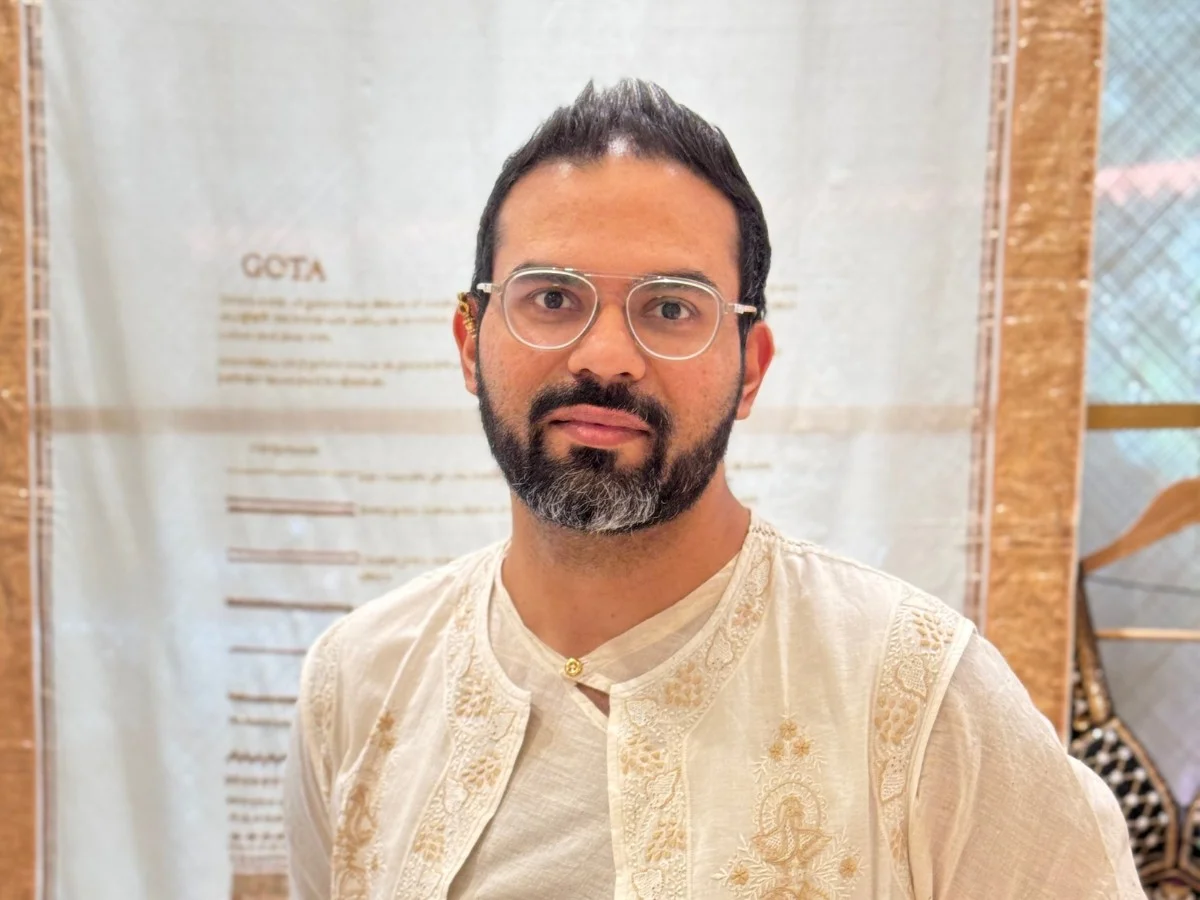
Image Credit: Pankaj S Chadha
A couture label can be run in two ways. You could operate as if the fashion space is like a rannbhumi, where you perpetually compete or contest against contemporaries to stay relevant. But, Pankaj S Chadha does not suffer from such FOMO that will make him ‘cling swords in a battleground’ in order to be constantly visible in the realm of bespoke luxury. An artist that he is, Pankaj would instead revel in a rangbhumi; immerse himself in the beauty of a craft conjured up by an artisan, acknowledge the passion breathed into it and derive almost an orgasmic pleasure in its expression and consequent celebration. For, as the purist himself explains, “When you are dedicated to the arts to the point of being a devotee of Maa Saraswati, fruitful commerce will arrive in the form of Maa Lakshmi. And once that is achieved, Maa Durga blesses you with fame! It’s a process to be adhered to prodigiously, without any shortcuts.”

In an age when society is perpetually pandering to instant gratification, exhibitionism and easy fame, Pankaj’s evolution as an artist who celebrates the legacy of Indian heritage crafts has been gradual. His steady growth however ensured that he is able to sustain the kind of work he had embarked on doing. Too many couture houses believe in the number game, but Pankaj S Heritage steered clear of that maths. The idea was never to just churn out and sell, which, he clarifies, would have been really easy. “As someone who is incessantly inspired by the richness and diversity of Indian hand embroidery techniques, the aim was to showcase high quality needle work on exquisite textiles the connoisseur would get awed by and eventually aspire to own. This can only be achieved with patience and perseverance. The people who fell in love with our work understood why the process needed time. The turnout phase is slow, which is the one of the basic tenets of quiet luxury,” he explains. With this preamble to the exploration of the bespoke atelier, the conversation becomes even more enticing with the couturier who is perpetually balancing his role as an artist as well as a showman ever since his label was launched in 2018. He admits though that while he began as a designer and eventually took on the painstaking work of a revivalist, currently he would like to call himself a curator. “The brand is of course making the finest of fine couture showcasing hand embroideries from yore but the duty transcends mere commerce. While it is heartening to see our creations appreciated and worn by true purveyors of art, there is an added responsibility of identifying artisan clusters and nurturing them so that they are enthused to raise the bar of craftsmanship. We keep hearing that children of artisans do not want to continue in the field. This dialogue requires immediate discussion in fashion circles. Designers have to come forward and nourish such artisans so that lopsided market dynamics do not eat into their livelihood. At Pankaj S Heritage, this is one of the main activities we do. We adopt clusters and strengthen them because the goal is to save crafts that our country was initially celebrated for the world over. It is not just about reigniting the interest for them in a landscape riddled with crass commercialisation and the influx of substandard machine made knockoffs but also to establish a design vocabulary surrounding these heritage embroideries so that they seamlessly acquire a definition of bespoke fashion and unquestionable luxury when scrutinised globally!”


Presently working with almost 15 artisan clusters based in Srinagar, Lucknow, Rampur, Jaipur, Udaipur, Murshidabad, Burdwan and Kochi, the label is a stickler for quality over quantity. With the level of work that is rendered on handwoven textiles, Pankaj believes that the gestation period of such creations would obviously increase. Like in the hawa ka kaam that the atelier has brought back into couture, it is an embroidery that needs absolute precision and dexterity. “You cannot rush the artisan because this embroidery is literally like running the needle in air. Earlier people had ample time to take up this craft. When we encouraged the artisans who knew this work to practise it again, the initial scepticism was would the embroidery find takers? Also, whether anyone would be willing to pay for the man hours invested in this kind of embroidery. But then, we have reached that kind of audience who are willing to understand, learn and appreciate what goes behind the ensembles we create. Hence, the price tag has never been an issue in this journey of client consolidation,” elaborates Pankaj giving us a glimpse of the ethereal hawa ka kaam on a pale pink jacket. Almost resembling a fine spider’s web, it is difficult to imagine how a human hand could deliver this artistry. But then, that’s the awe-inspiring charm of the craft legacies Pankaj is penning.
Available in multi-brand outlets in Delhi, Ahmedabad, Hyderabad and Mumbai, Pankaj S Heritage creations are hardly a single craft piece. The ensembles are a confluence of embroideries from different places in India so that it is a layered heirloom collectible. “Take for example this 400 count Muslin saree. The fabric was handwoven in West Bengal by weavers who are known for their expertise with the finest jamdani muslin textiles. Then this was sent to Lucknow for the do-taar Chikankari which took months because of the extremely delicate base. After that was done, Baadla karigars of Rampur worked on it and thereafter we got intricate gota patti done on it from Rajasthan. The creation was finished with beetle wing detailing. If this is not a celebration of what Indian crafts has to offer I don’t know what is!”


Born and brought up in Delhi, Pankaj armed himself with a fashion design degree from NIFT before launching a label for populist fashionwear. A few years later though, he itched to channelise his creativity into a realm that would focus more on India’s ancient craft traditions. Essentially, he researched and documented embroideries that royals and nobility patronised before incorporating them on handwoven fabric, giving his creations not just the glorious stamp of handcrafted in India, but also making them aspirational, coveted creations cherished as heirloom that could well be showcased in museums. “At the atelier, we want to educate patrons when they walk in. I take them through certain elements that make this space not just a couture studio. It’s also about educating people about the history of these crafts so that they value this heritage. Revival is a time consuming affair that requires a supportive audience so that these craft forms find a future for themselves,” explains Pankaj.
It is evident why the design virtuoso devoted concentration in single piece ensembles that would stand out amidst the melee of random blingy fashion because each piece is made with singular attention to the minutest detail.
The point was to be a custodian of artfully done ensembles that showcases the wizardry of award-winning artisans, master weavers and miniature painters. And it is for this very reason that Pankaj doesn’t ask an artisan how much he should pay for a hand embroidered creation once it is completed. Spellbound by the intricacy of the heritage art, he inquires how much he should ‘nyochhawar’ on it according to the karigar. “The beauty, details and finesse of the embroideries render these creations priceless. Money cannot quantify the man hours going into them. To ask the karigar ‘how much do I pay?’ would trivialise his artistry. As a mark of respect for his artisanship we use that word. To hold his craft traditions in high esteem,” signs off the craft maverick.
“Revival is a time consuming affair that requires a supportive audience so that these craft forms find a future for themselves.”
Image Credit: Pankaj S Chadha