
A Sanctuary for Nature Lovers
The Jambughoda Palace is a royal family run heritage home in Gujarat that welcomes guests with a yen for not just time spent in the lap of nature but also indulge in a truly sustainable lifestyle that is far from the madding crowd.
By Sharmi Adhikary

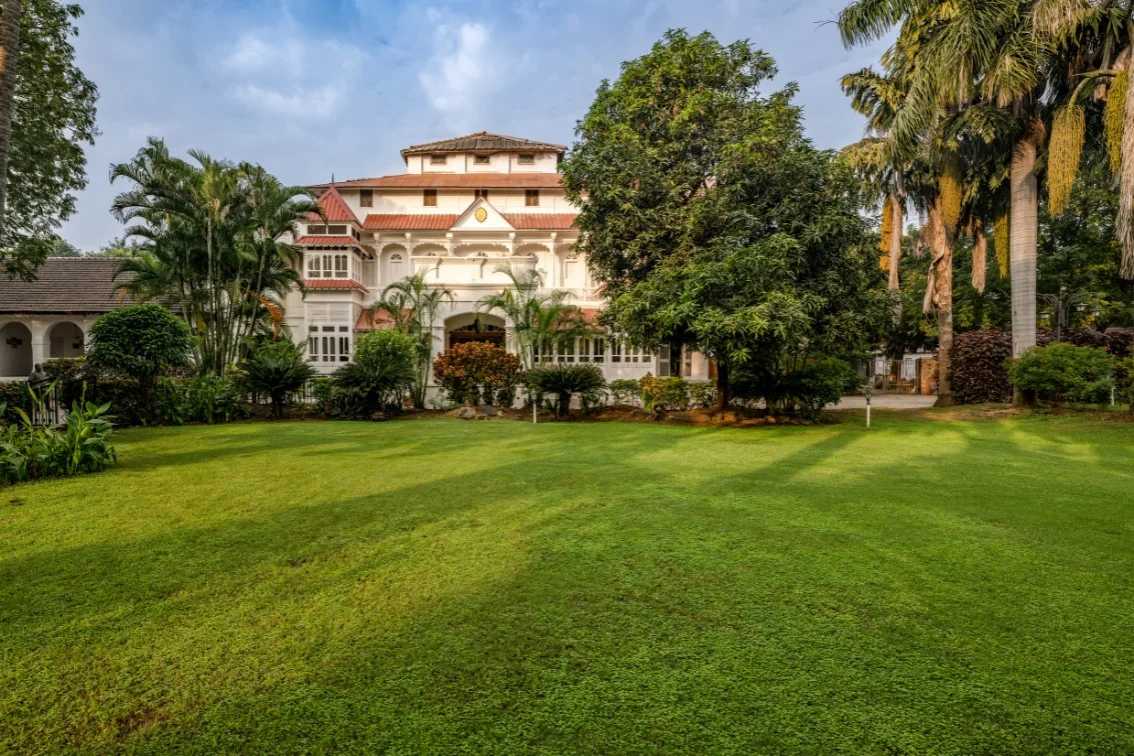
Explores the Jambughoda Palace in Gujarat, a royal family-run heritage home that offers a sustainable and nature-centric getaway. The palace, owned by Maharana Vikramsinhji, showcases eco-friendly practices, organic farming, and a commitment to preserving the environment and cultural heritage.
There are places in this country that not many of us have even heard of. In the age of fancy travel itineraries and heavily stylised holiday packages doled out by companies trying to cash in on the passion that a traveller holds about exploring new territories, these retreats are like well-kept jewels with years of history attached to them. Once you discover them, you will be spellbound by the tales these structures carry in their precincts. The Jambughoda Palace is one such retreat protecting not just the legacy of the royal family who have taken care of it for more than 250 years, but the way in which it offers itself to the consummate traveller there is a sense of deep respect for its environmental surroundings as well as the sustainable module of living it has learnt from nature itself.


The palace, owned by HH Maharana Vikramsinhji, is the nerve centre of Jambughoda that is a mere two-hour drive from Vadodara. The place huddles sleepily at the foothills of the Vindhyas, deep within the Panchmahal district of Gujarat and you might experience the perfect road trip that takes you through Champaner — a world Heritage site. It meanders through lush green teak and bamboo forests interspersed with tribal pockets. The dense foliage and the rustic charm of the property is a sight to behold even as it takes you back in time as you desire to explore its beauty bit by bit. Each room in the beautiful, red-tiled roof houses scattered on the Palace grounds has a story to tell about the life and time of people in the distant past. Period furniture fills the cosy and neat rooms to ensure comfort to the guests. Interestingly, Maharana Vikramsinhji resides at the Palace with his family and if one is lucky they can request to meet them too. The members of the Jambughoda royal family are descendents of the Parmar Dynasty from Dhar in Madhya Pradesh. Their ancestors ruled the state, till its merger with the Indian Union in 1948.
Spanning more than 12 acres, this family-run heritage home that was opened for hosting guests in 2000 is part of a larger area that includes an organic farm, which provides vegetables, cereals, pulses and fruits for guests, and a mango orchard which boasts of 3000 trees with 10 different varieties of mangoes. The palace itself, which is more than 250 years old, was once the heart of the former princely state of Jambughoda. Notably, Maharana Vikramsinhji, is a known environmentalist who played a pivotal role in securing Wildlife Sanctuary status for the adjacent Jambughoda forest. This commitment to the environment is evident within the palace grounds, which feature an organic farm, numerous mango trees, and a variety of biodiversity, making this retreat an ideal destination for reconnecting with nature. Do not expect liveried waiters in this family-run place but guests are pampered with personalized service and attention to details that make the welcome warm and stay memorable. Over the years the retreat has gradually earned its place in the reckoning to nature lovers who want to spend time in the lap of nature while exploring the flora and fauna in the surrounding forest sanctuary while understanding how the family has successfully nurtured so many species of plants and trees on the place grounds even as they follow as well as offer a lifestyle that is simple, tuned to our roots and is wholesome maxwin288

To ensure that guests respect, gauge and in turn follow these eco-friendly principles during their stay, there is a consolidated effort to slowly educate them about how the palace retreat is maintained and run. “The traveller today is extremely discerning so when they see our operations they realise how we ardently run this place and conduct our lives following some principles. We use what we have. We eat what we grow. There is a consolidated effort to conserve. The food we eat and serve here uses local cereals, pulses, fruits and vegetables. The cooking incorporates herbs rather than aromatics. Neem smoke is used in the gardens and open areas to ward off mosquitoes. We use farm yard manure in the agriculture fields,” informs Karmaveersinh Rana, Maharana Vikramsinhji’s son. This home for nature lovers takes delight in hosting their guests in the wilderness. Home-cooked organic food is served al fresco and dinners are also organized around campfires for the more adventurous ones.
The food is slow-cooked on wood to suit both vegetarian and non-vegetarian palates. “We grow our own vegetables, grains and fruits with minimum use of natural fertilizers and insecticides. There is no plastic usage in the farms and fields. The dishes are made from recipes that have been passed on from one generation to another. We selected them carefully so that the guests can savour what’s best from our culture and the place. The family has tried to preserve the age-old cooking methods and flavours, which would have otherwise been lost in time,” he says.

Considering this is a place that values the sights, sounds and smells of nature and steers off from synthetic incorporations and distractions that disturbs tranquility, the rooms at the retreat do not have televisions. Instead, guests are encouraged to spend time outdoors exploring the gardens. “Because of the surrounding forest sanctuary, Jambughoda is a pollution free area and guests do appreciate that they are breathing 100 percent oxygen. They go trekking and on nature trails. We discourage the playing of loud music, using horns and we try to restrict large crowds. Thankfully, due to the declaration of the forests as a sanctuary, no factories will be allowed to set up in the vicinity. To extend the sustainable module here we use matkas and clay pots to serve water and cooling drinks. The wooden design used in the roof ends is an indigenous and ancient craft form. We also take our guests for safaris and trips to the tribal haats from where they buy local handicrafts and Pithora paintings,” elaborates Rana.
Anyone visiting the Palace retreat in the taluka of Jambughoda can witness how the place boasts of a diverse heritage of flora and fauna. The royal family has tirelessly worked at preserving these forests, before and after they were nationalized. Five generations of the family have been contributing towards this work. Maharana Vikramsinhji has continuously helped minimise the illegal felling of trees with the help of the vigilance department and motivated people to plant indigenous species of plants during monsoons. “We tell all this to our guests when they come to stay with us. We take them around to show the work being done and they are privy to the beauty around when they go for wildlife safaris from here. This is to inculcate in them the love for nature and the appreciation that if we do not take care of what we have around us in nature we will lose our heritage eventually and our identity through that. The coming generations need to realise this and adapt to the green way of living,” Rana sums up pertinently.
Points from the Royals to promote for green tourism
a. Plastic must be effectively banned.
b. Every school should have lessons on cleanliness.
c. Severe punishment for persons throwing garbage all over the place.
d. Encourage the general public to grow more trees.
Empowering Farmers and Women
Maharana Vikramsinhji had worked with Dr. Verghese Kurien at the National Dairy Development Board in the 1970s. He and Late Maharana Digvijay Sinhji encouraged the farmers at Jambughoda to start the first milk cooperative in the Jambughoda Taluka with 11 members. Though they were reluctant initially, today Jambughoda has a milk collection of 10,000 lts to 13000 lts, with 34 milk cooperatives out of which 4 are fully operated by women. Approximately 5000 farmers, of which 1500 are women, have benefitted from this work.
Visit www.jambughoda.com to explore more about the heritage retreat