
Aaranyam: Not a 115-year-old home stay, but an unmatched experience.
Tucked away in the serene hills of Ranikhet, Uttarakhand, Aaranyam is not just a homestay or a getaway, it is an experience, a philosophy, and a lesson in slow living. Built by Kumar Shivam, an artist, filmmaker, writer and heritage enthusiast, Aaranyam reflects a conscious choice to revive intangible heritage, restore cultural narratives, and craft an immersive journey that connects people to the roots of Kumaon and Garhwal in Uttarakhand.
“I didn’t make it a museum; I made it useful,” Shivam begins. “Even today, the water we provide comes from a big copper pot, just like people used to use a hundred years ago. Everything here is about bringing the past into the present.” MOSAIC explores what Kumar Shivam, Founder of Aaranyam means by living the simple-slow life, immersed in culture, stories, traditions, values and ancestral legacy.

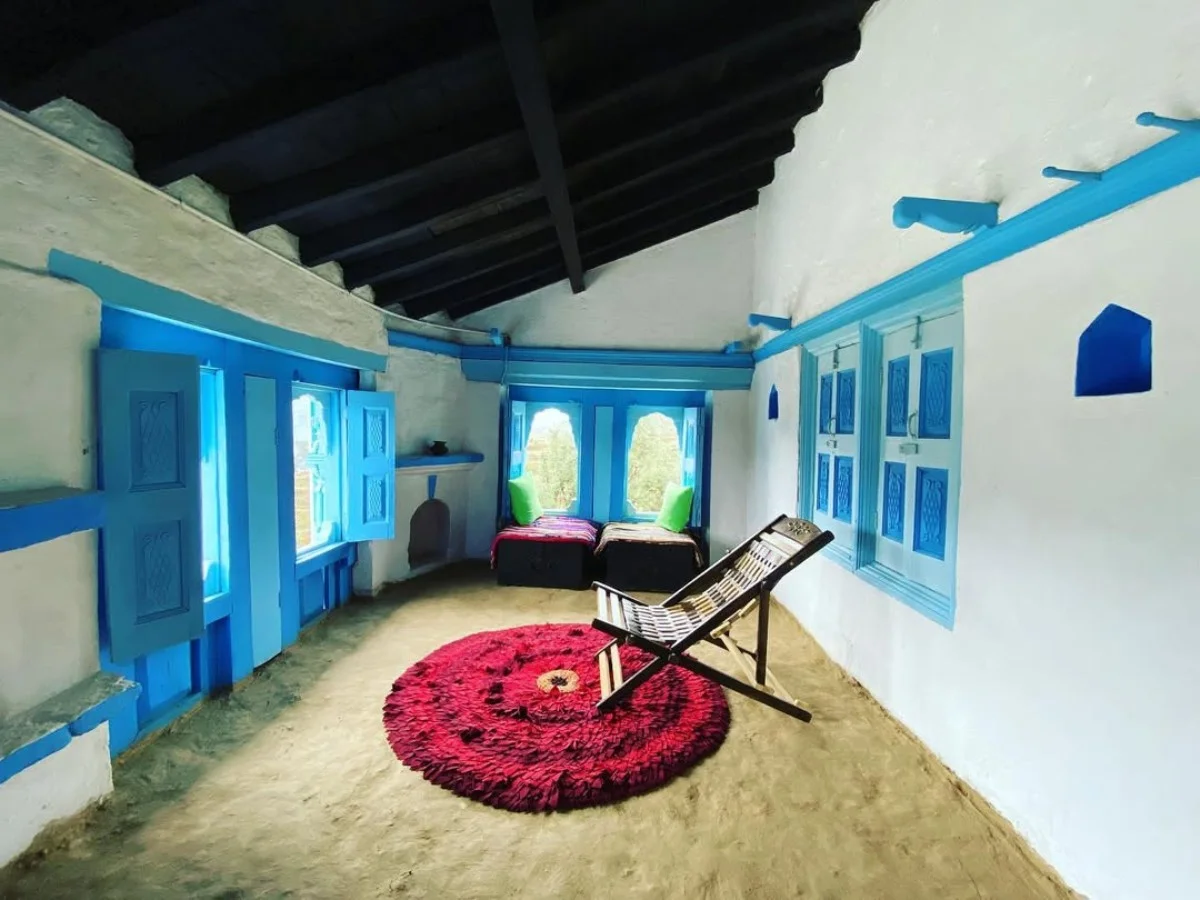
Heritage as Living Experience
From the very beginning, Shivam’s focus was on intangibles over tangibles. His aim was not to dazzle with luxury or modern gadgets, but to restore the authentic rhythms of village life. At Aaranyam, energy consumption is minimal, only light bulbs are used, no geysers or mixer grinders. Meals are cooked on traditional stoves in steel pots. Guests are invited to live as their ancestors did, experiencing a simpler, slower, and more conscious rhythm of life.
“I talk to every person who comes here,” Kumar Shivam explains. “I am restoring culture. People may come thinking they are just coming to enjoy, but enjoyment here has a different meaning. They engage, they observe, they connect.”
The project was born from Shivam’s fascination with the past. “I am very much attracted to old things. Emotions are lost in today’s world, so if you want to feel something authentic, you have to visit Aaranyam.”

Crafting Time Travel
For Shivam, Aaranyam is also an experiment in time travel. He draws a distinction between physical time machines and the emotional time travel one can achieve by immersing in heritage. “If you listen to an old song or engage with an ancient practice, you travel in time in milliseconds. That is the experience I wanted to create at Aaranyam for our visitors, something no luxury hotel can give them.”
The creation of Aaranyam took two years. Every piece of wood, every stone, and every lamp is either antique or crafted using methods from the past. “Even the wood here is centuries old. The lamps are made from logs that have been rotting for years,” he shares. Collaborating with his former students from the College of Arts in Delhi, he involved villagers to ensure that the restoration preserved authenticity.
Community at the Core
Shivam tells us that Aaranyam is not just his project, it is a collective effort, where the local villagers are integral to the experience. They perform live music, cook meals, share stories, and interact with guests. Every visitor must adhere to our rules to ensure the experience remains true to the vision: no Wi-Fi, no outsourced entertainment, and no commercial distractions.
“We only have three rooms,” he notes. “Guests who come here may seek relaxation, but they must follow the rhythm of village life. Even sweeping the soil floor is an experience for someone who has never done it before.”
The approach also extends to marketing, Shivam carefully plans the way Aaranyam is presented on social media, avoiding typical commercial language like “booking” or “offers.” Instead, he evokes curiosity and suspense, drawing people into a story. “Writing beautifully attracts the right audience. Like an artist draws attention with a painting, I do it with words,” he says.
Food as a Cultural Narrative
Aaranyam’s meals are another key medium of heritage. Guests eat what the local women cook and eat from fenugreek coffee, cumin curry, ‘bichoo ghas ka saag’, and other traditional items. Shivam personally narrates stories behind each dish, connecting food with history and emotion. “Food is beautiful, before feeding guests, I tell their stories. It is a ritual that deepens the connection with the village,” he explains.


The Village and Its Youth
Beyond the walls of Aaranyam, Shivam is deeply concerned about the future of Uttarakhand’s villages. Depopulation, commercial pressures, and loss of cultural knowledge are threatening the region. “Our villages are empty because people leave for education and jobs, migrate to cities. Children walk 8 km to school, and many elders are left helpless. Yet, they have the heritage and stories we must preserve,” he says.
He observes two types of youth, he says, one in urban centers, curious and globally oriented, and another in villages, aspiring only to leave and make a better living for themselves. “The challenge is to make staying here aspirational. I want youth to see opportunity in their homeland, for them to stay and protect their lands and culture.”
To this end, Shivam trains local youth to manage hospitality in a way that preserves culture. From teaching pottery and wall art to guiding traditional farming practices, Aaranyam is a training ground for skills that honour heritage while providing economic opportunities. “Everyone is connected, even the driver is from the village, not a city. We show young people that dreams can be achieved here,”
Lessons from Elsewhere
Shivam draws inspiration from other models of community-driven preservation, such as a clean village in Meghalaya, which he describes as a “dreamland” where education, sustainability, and pride coexist seamlessly. He believes Uttarakhand could replicate such examples, combining cultural pride with modern education and economic stability. Kumar has big dreams for Uttarakhand and is working in the direction to achieve that.

Responsible Tourism
The surge in homestays and resorts across Uttarakhand has diluted authentic village experiences. “Many properties treat guests as a means to earn money, and the soul of the place is lost. At Aaranyam, we do not outsource experiences, as you can see the village itself hosts you,” Shivam stresses. By keeping operations localized, slow-paced, and culturally rooted, Aaranyam avoids the pitfalls of mass tourism. Guests leave not with souvenirs, but with memories and insights into a living culture. We focus on quality than numbers, and personalised engagement is our key.
Stories, Myths, and Living Heritage
Every corner of Aaranyam carries stories. The 400-year-old trees, ancient stones, and water sources are witnesses to centuries of history. Shivam recounts tales of the Ramayana printed in 1939, Ram Leela performed in his house for three years, and even political history, such as plans to release Jawaharlal Nehru from Chowpatty that involved the local Kumaon Regiment.
There is a stone behind the house, whose face once faced the village causing tragedies. Local people often said that deities turned the face to the ground, bringing peace. The surrounding forest, rivers, and lakes, all man-made or natural add layers of mythology, history, and culture. Visitors experience not just scenery, but a narrative woven across time. Kumar Shivam is a true storyteller, from his experience in advertising and as a writer, he says his skills come useful in fervently promoting Uttarakhand, and by stories that reside in the hills and in its people.

Architecture as Storytelling
Aaranyam’s architecture reflects centuries of Kumaon heritage, with three floors, stone walls, and wood structures that are historically accurate. Even tin roofs are integrated in ways that do not compromise authenticity. Every room, every staircase, and every courtyard is a lesson in sustainable construction and cultural storytelling. Shivam is reviving ancient walking trails, from Almora to Pithauragarh and Ranikhet to Karnaprayag, which were once arteries of trade, culture, and festivals. He envisions a 5 km open-air gallery, where the village itself becomes a living museum displaying art, stories, and folklore. “You can see Uttarakhand’s culture while driving. The entire stretch is an exhibition of our heritage,” he says. Creating Aaranyam was not without challenges. Securing local buy-in, navigating construction limitations, and resisting commercialization required patience and strategy. Shivam credits his father, who supported him through traditional methods of construction, and the village community who gradually became partners in his vision.
“It took 3-4 years to gain the trust of locals. Without their love and participation, none of this would have been possible,” he explains.
Lessons for Individuals and Society
Shivam’s reflections extend beyond Aaranyam. He emphasizes that preserving heritage is a collective responsibility, requiring individual engagement, community action, and cultural pride. “The question of preservation has existed for 30 years. We must not just ask, we must act. Complaining will not help.”
He advocates for education rooted in culture, awareness of local history, and intentional engagement with the natural world. Nature itself, he argues, is a teacher and healer: “Sit by the trees, listen to the wind. You don’t need fancy mind classes. Everything you need is already here.”
Shivam’s ambition for Aaranyam and the surrounding village is both practical and poetic. He wants to create economic opportunities, revive walking trails, engage youth, and preserve cultural heritage. The village will remain a space where art, story, food, and environment are intertwined, demonstrating that sustainable living and economic vitality can coexist.
Aaranyam is more than a homestay; it is a philosophy of life, a preservation of culture, and a model for sustainable community-driven tourism. By weaving together the tangible and intangible, the past and present, Shivam reminds us that living fully is an art—a lesson in connection, responsibility, and reverence for heritage.
“I came to Aaranyam to see how India once lived. Our ancestors lived beautifully, and we exist. That is the difference,” he says. For visitors, Aaranyam offers not just a retreat, but a rendezvous with time, culture, and the essence of human experience.
“This is Uttarakhand’s chance to remain Uttarakhand. If we preserve it, we inspire not only ourselves, but other states too,” he concludes.