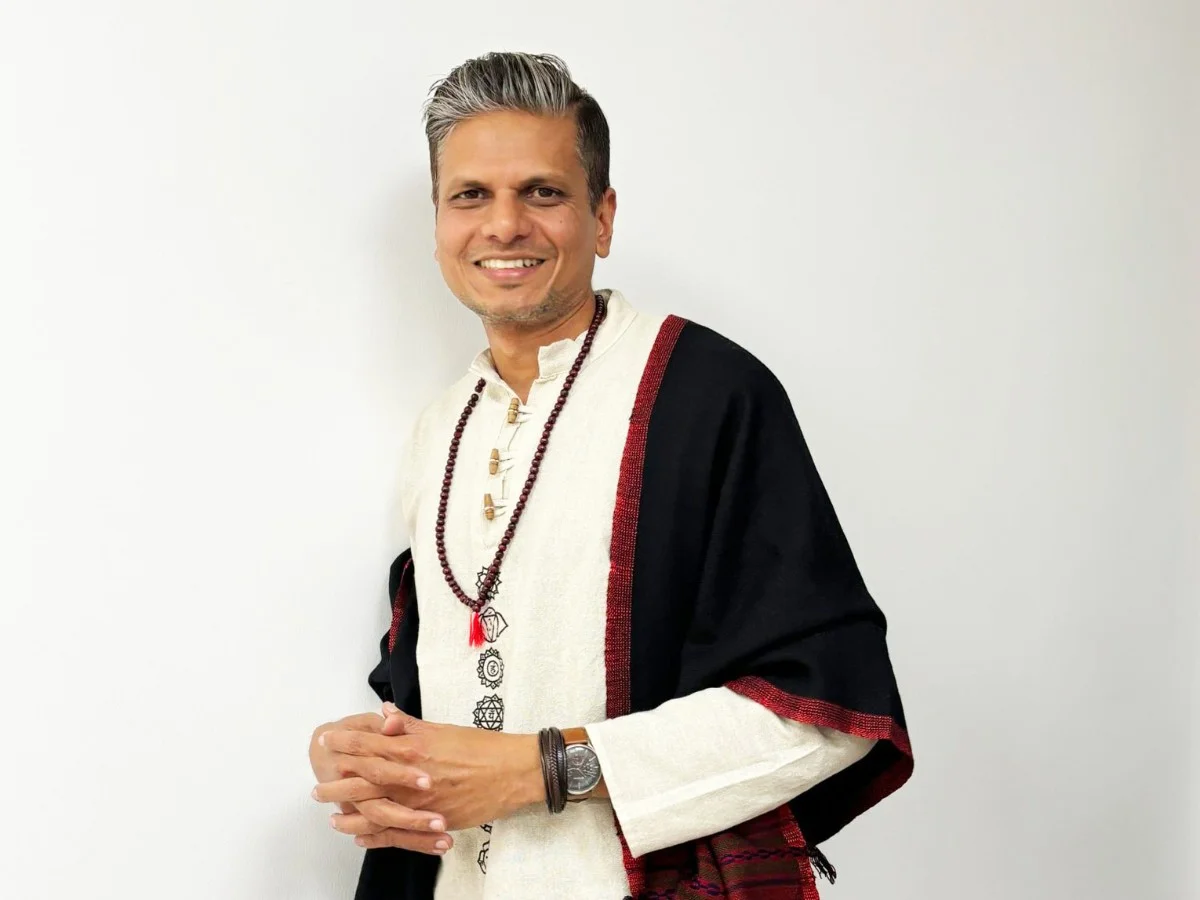
MOSAIC: What inspired you and how did The Folk Tales come into existence?
Gaurav: It started quite organically. I wasn’t always this connected to India. In fact, I had plans to settle abroad. But I slowly realised that I knew so little about my own country. We grow up celebrating Diwali and Holi, but India has thousands of other festivals, each with a story behind it. So I began travelling, first locally, then across different states. Along the way, I met communities, stayed in their homes, and heard about their stories and traditions. That opened my perspective on India and its heritage and that’s when the idea clicked, what if I could design tours that are not about ticking boxes on a sightseeing list, but about living the culture?
That’s how The Folk Tales was born which is now a platform where travellers can connect with India’s traditions, folklore, and our rich heritage through authentic local experiences.
MOSAIC: You host both Indian and international travellers. Do you find one group easier to manage than the other?
Gaurav: It’s less about easy or difficult and more about expectations. With Indian tourists, the challenge is often that they want urban comforts even in a rural village. For example, some parents get upset if their kids get dirty playing in the mud. But that’s the essence of village life and it’s healthy, it builds resilience. These are moments you can’t always plan for in advance.
International tourists, on the other hand, never expect star hotels in villages. But they do have practical concerns such as the type of washroom, heating arrangements, mattresses, food hygiene, safety or whether they’ll stay connected to the internet. Their main priorities are hygiene, connectivity, and good food. So, it comes down to communication. We set expectations clearly from the start for both groups. That way, there’s little room for conflict.

MOSAIC: Out of all your years of work, can you share one story that really left an impact on you?
Gaurav: Yes, and it’s quite personal when I worked in the UK, one day a British colleague asked me about Makar Sankranti. And I had no idea. I made up a story on the spot just to answer him, but later, I felt guilty. How could I, an Indian, not know about such a major festival celebrated across the country? That incident pushed me to read and explore more. Over time, I discovered that Makar Sankranti isn’t limited to India. It’s celebrated in Sri Lanka, Nepal, Thailand, Laos, Cambodia under different names. In Thailand, it’s called Songkran. In Assam, it’s Bihu. Each version celebrates harvest of crops and renewal.
This realisation was powerful and opened my perspective on travel and my own country. It showed me how Indian civilisation has influenced and connected with Southeast Asia through trade and cultural exchanges for centuries. It reminded me that our stories don’t stop at India’s borders, they’ve travelled across oceans.
MOSAIC: That’s fascinating. Do you see this as part of India’s forgotten history?
Gaurav: Absolutely. Many people assume Indian civilisation was always invaded, always conquered, and never ventured out. But when you look at Southeast Asia, you find hundreds of Shiva and Vishnu temples in Thailand and Cambodia, rivers flowing over Shiva Lings in forests, and of course, Angkor Wat.
Even in Indonesia, Bali is deeply influenced by Indian traditions and festivals and our culture. These aren’t coincidences if you read, they are evidence that Indians travelled, traded, and carried their culture abroad. We weren’t passive, we actively contributed to a shared history of this region.

MOSAIC: Rajasthan is one of the top-selling destinations for your tours. What makes it so appealing to travellers, and what kind of travel experiences do you offer there?
Gaurav: Rajasthan is hugely popular, not just because of its iconic forts and palaces, but because it has been extensively publicised abroad. Tourists are drawn to its vibrant culture, heritage, and storytelling traditions. For us, the experiences go beyond sightseeing. We design tours that allow visitors to engage with local artisans, understand traditional crafts, and witness life in villages. For example, we have textile and craft workshops in Jaipur where tourists can interact directly with artisans, learn about the techniques, and even try their hand at weaving or dyeing. These immersive experiences help travellers appreciate the culture in a way that goes far beyond visiting monuments.
MOSAIC: You also conduct tours in Northeast India, share what makes these experiences unique?
Gaurav: The Northeast is incredibly special because of its natural beauty and rich cultural diversity. For instance, in Assam, Meghalaya, and Sikkim, we design experiences that focus on local traditions, crafts, and food heritage. We offer textile workshops where visitors can watch silk extraction and weaving, and even participate if they want. We also focus on authentic food experiences like cooking with the Karbi, the indigenous community in Assam using native herbs and spices, or dining with the Khasi community in Meghalaya where meals are cooked inside bamboo. Beyond that, we also do offbeat trekking and nature tours, taking travellers to places where they won’t find any other tourists. It’s about creating meaningful connections with both the land and its people.

MOSAIC: How do you tailor tours for clients with specific interests or time constraints?
Gaurav: All our tours are customisable. We start with template itineraries, but every client modifies them based on their interests like textiles, local crafts, heritage, or cuisine. For travellers with fewer days, we still ensure meaningful experiences by recommending at least two nights in each location instead of rushing through multiple cities. For those with more time, we design extended tours lasting 14 to 15 days, combining highlights like Taj Mahal and Jaipur with niche experiences such as artisan workshops or culinary immersion. The focus is always on storytelling and authentic engagement, not just sightseeing.
MOSAIC: In today’s modern world, people are moving away from cultural roots. Do you think this threatens traditions and the kind of work you do?
Gaurav: I see it as a cycle. Sometimes people are deeply connected to culture, and other times they drift away. Eventually, the circle completes, and they rediscover what’s meaningful. So, I don’t worry too much as there are enough people interested, and enough stories to tell about India. But yes, in places like Uttarakhand, Himachal villagers are migrating to cities for jobs, with them, stories, songs, and traditions slowly disappear. Unless people like us document and share them, future generations will inherit very little. And then there’s the environmental aspect of over-construction, cutting forests, hotels being built dangerously close to rivers. These things destroy not just ecology but also cultural landscapes. Rivers need breathing space. Villages need identity. If we replace them with concrete hotels, both nature and culture suffer.
MOSAIC: What can stop this outmigration from villages?
Gaurav: Two things, infrastructure and opportunity. Internet access is a game-changer, when I first started travelling in 2014, there were villages where you couldn’t get a signal for ten days. Today, if you don’t have internet, you’re isolated and cut off from countless business opportunities. With connectivity, even a small-town creator can showcase their village to the world without moving to Delhi. But they also need support systems such as better healthcare, clean cooking solutions, and self-sustaining small-scale local enterprises. For example, when smokeless stoves were introduced in Kumaon, women no longer had to suffer from smoke-related illnesses and not leave their houses and move to bigger towns. That kind of change matters.

MOSAIC: You referred to responsible tourism and sustainability when describing your work. Could you explain the difference between the two and how they guide the way you design tours?
Gaurav: In our work, sustainability and responsible tourism are closely related but not exactly the same. Sustainability, as we understand it, has three key dimensions; environmental, economic, and cultural.
- Environmental sustainability means leaving as little impact on the environment as possible—minimising waste, energy use, and disruption of surroundings or resources.
- Economic sustainability ensures that local people are fairly compensated. We work directly with artisans, guides, and homestays, pay them pre-agreed rates, and avoid middlemen.
- Cultural sustainability is about highlighting, nurturing, and sometimes reviving local traditions—food, architecture, music, festivals, or clothing.
Responsible tourism, on the other hand, is our role as a tour operator to ensure that sustainability is actually incorporated into every tour. It’s taking responsibility for making sure that these principles aren’t just theoretical, but practiced in real life during every experience we create.
same time, the younger generation now dreams bigger, they want SUVs in the village, they want to be the next Ambani. That shift has its pros and cons, but at least they’re seeing their village as a place worth staying in, not just leaving.