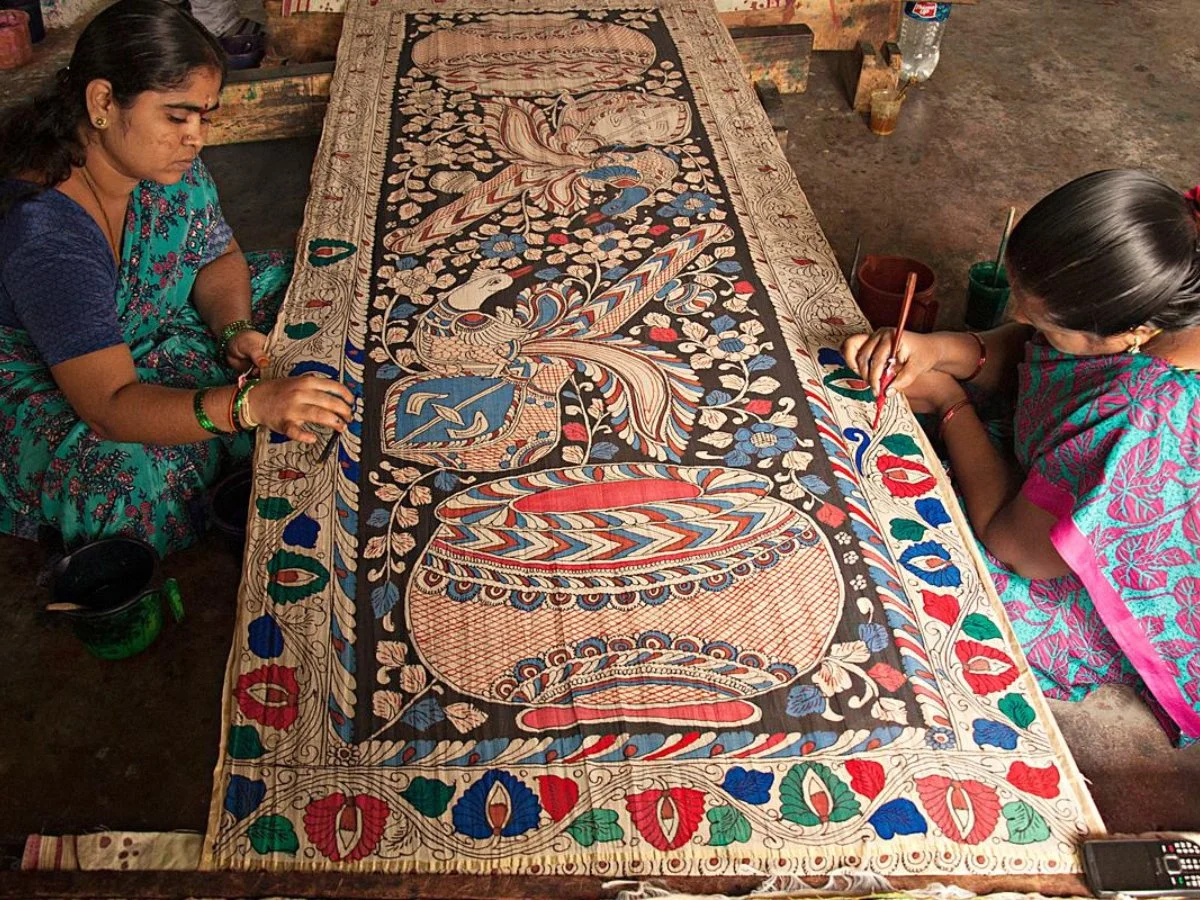
A Brief History
Kalamkari, which translates to “pen work” in Persian, has its roots in the 3rd century BCE, during the Satavahana dynasty (Source: “Kalamkari: A Traditional Indian Textile Art” by INTACH). This ancient craft was initially used to create intricate designs on fabric, often depicting mythological tales, which adorned temples, palaces, and sacred spaces.
Over centuries, Kalamkari evolved and adapted to changing artistic influences. The Mughal and Golconda kingdoms played a significant role in its development, refining motifs and expanding its use beyond religious settings (Source: “The Art of Kalamkari” by the Crafts Council of India). Eventually, the art form found international recognition when European traders, particularly the Dutch and the British, began exporting Kalamkari textiles to different parts of the world.
Symbolism & Aesthetic Appeal
Kalamkari is more than just a craft—it is a storytelling tradition. The hand-painted and block-printed textiles often feature intricate depictions of nature, mythological characters, and folklore. Each design carries deep symbolic meanings, making Kalamkari a visual archive of India’s cultural identity.
The natural dyes used in Kalamkari, derived from plants, flowers, and minerals, make it an eco-friendly alternative to synthetic textiles. This aspect is increasingly relevant today as consumers seek more sustainable fashion choices (Source: “Kalamkari: The Ancient Indian Art of Hand-Painting and Block-Printing” by the Government of India’s Ministry of Textiles).

Modernity & The Challenge of Fast Fashion
Despite its rich legacy, Kalamkari faces significant challenges in the contemporary market. The rise of machine-made textiles and the dominance of fast fashion have marginalized traditional crafts. Many artisans struggle to sustain themselves due to low wages and declining demand.
According to a report by the All India Handloom Board, the number of artisans engaged in Kalamkari has been decreasing, with younger generations opting for more lucrative career paths (Source: “The State of Handloom Weaving in India” by the All India Handloom Board). The painstaking process of Kalamkari, which involves multiple stages of dyeing, washing, and intricate detailing, does not always align with the fast-paced consumer culture of today. generation through exports. The Andhra Pradesh government has designated Kalamkari as the “One District One Product” for Krishna district, promoting its production and cultural significance.
Government & Institutional Support
The Indian government has taken several initiatives to protect and promote the Srikalahasti Kalamkari art form. The Geographical Indications of Goods (Registration and Protection) Act, 1999, has registered Srikalahasti Kalamkari as a geographical indication, ensuring its authenticity and exclusivity preventing it be copied or reproduced without permissions and approvals. The Andhra Pradesh Economic Development Board has also taken steps to promote the art form, solve industrial challenges, and improve revenue generation through exports. The Andhra Pradesh government has designated Kalamkari as the “One District One Product” for Krishna district, promoting its production and cultural significance.


Top Tour Operators to Consider
For those interested in experiencing the beauty of Srikalahasti Kalamkari first-hand, here are some top tour operators to consider:
– Sri Venkateswara Institute of Traditional Sculpture and Architecture (SVITSA): Offers a professional course on Kalamkari painting and provides a glimpse into the traditional art form.
– Dwaraka: An NGO dedicated to promoting Kalamkari and providing vocational training to craftspeople, especially women.
– Kalakshetra Foundation: A renowned institution that holds workshops and classes on Kalamkari, supported by the Ministry of Culture, Government of India.
Traveling to Srikalahasti
Srikalahasti is easily accessible by road and rail, with the nearest airport being Tirupati Airport. The town offers a range of accommodations, from budget-friendly options to luxury hotels. Visitors can explore local workshops, markets, and artisan studios to experience the art form and purchase authentic Kalamkari products.
Distances from Srikalahasti town to major cities:
– Chennai: Approximately 110-120 kilometres, about 2.5 to 3 hours by road
– Tirupati: Approximately 36-37 kilometres, about 1 hour by road
– Hyderabad: Approximately 400-552 kilometres, around 8 to 10 hours by road
You can travel to Srikalahasti by:
– By Air: The nearest airport is Tirupati Airport, about 36 kilometres away
– By Train: Srikalahasti has a railway station with regular trains connecting to major cities like Chennai, Hyderabad, and Tirupati
– By Bus: Regular bus services are available from nearby cities like Tirupati, Chennai, Hyderabad and Vijayawada
Nearby Temples to Visit
Srikalahasti is home to the famous Srikalahasteeswara Temple, a revered Saivite shrine. Other nearby temples worth visiting include the very famous and visited Tirumala Venkateswara Temple, the famous Hindu temple located in Tirupati, known for its spiritual significance and architectural beauty.

Buying Authentic Kalamkari Products
To ensure authenticity, it’s essential to buy Kalamkari products directly from artisans or reputable sources. Some popular options include:
– Local Markets: Explore local shops in Srikalahasti to find a variety of Kalamkari products.
– Artisan Studios: Visit artisan studios and workshops to see the artisans at work and purchase products directly.
– Online Platforms: Websites like iTokri, Craftsvilla, and Gaatha offer authentic Kalamkari products sourced directly from artisans.
How to spot real Kalamkari
Look for natural dyes with earthy tones that give the fabric a subtle, muted appearance. Irregularities like crooked lines, smudges, and small stains are characteristic of hand-painted Kalamkari. A milk-like aroma, resulting from

Famous personalities spotted in Kalamkari
Kalamkari sarees have been a staple in Indian fashion, adorning numerous celebrities and influencers. Some famous personalities who’ve been spotted in stunning Kalamkari sarees include:
Famous personalities spotted in Kalamkari
Kalamkari sarees have been a staple in Indian fashion, adorning numerous celebrities and influencers. Some famous personalities who’ve been spotted in stunning Kalamkari sarees include:


– Vidya Balan: Known for her impeccable style, Vidya Balan has been seen wearing exquisite Kalamkari sarees that showcase her love for traditional Indian textiles.
– Kangana Ranaut: A vocal advocate for handloom ensembles, Kangana Ranaut often wears Kalamkari sarees that highlight her elegant sense of style.
– Sonam Kapoor: This fashionista has been spotted in various Kalamkari sarees, effortlessly blending traditional and modern styles.
– Dia Mirza: A strong supporter of sustainable fashion, Dia Mirza has been seen wearing Kalamkari sarees that reflect her commitment to eco-friendly clothing.
– Shriya Saran: This talented actress has worn stunning Kalamkari sarees on various occasions, showcasing her impeccable taste in traditional Indian attire.
– Kalyani Priyadarshan: Known for her beautiful sense of style, Kalyani Priyadarshan has been spotted in elegant Kalamkari sarees that highlight her love for traditional Indian fashion.
– Taapsee Pannu: Was seen in a stunning hand-painted Kalamkari sari by Gaurang Shah, a designer known for reviving ancient Indian weaves and crafts through his intricate creations. His work ensures that Kalamkari remains relevant in luxury fashion.
– Shilpa Shetty: Made a striking appearance at the Champions of Change Awards in a custom Kalamkari sari by Nidhi Tambi Kejriwal, seamlessly blending tradition with modern elegance.
– Ayush Kejriwal: A designer known for his celebration of Indian textiles, has incorporated Kalamkari into his collections, highlighting the intricate craftsmanship in sarees, blouses, and dupattas. His pieces are often handcrafted with rich, earthy tones and mythological motifs, making them a blend of heritage and contemporary appeal.
-At Lakme Fashion Week 2024, Punit Balana showcased a collection featuring Kalamkari prints alongside Ajrakh and Bandhani, presenting the traditional craft in a fresh, modern light. His pieces redefined how Kalamkari can be worn in everyday and festive settings.